If you've been told you don't have enough jawbone for implants, bone grafting can rebuild your foundation. We perform all grafting procedures in-house in Hawthorne — no referral to an oral surgeon required.
WHY BONE MATTERS
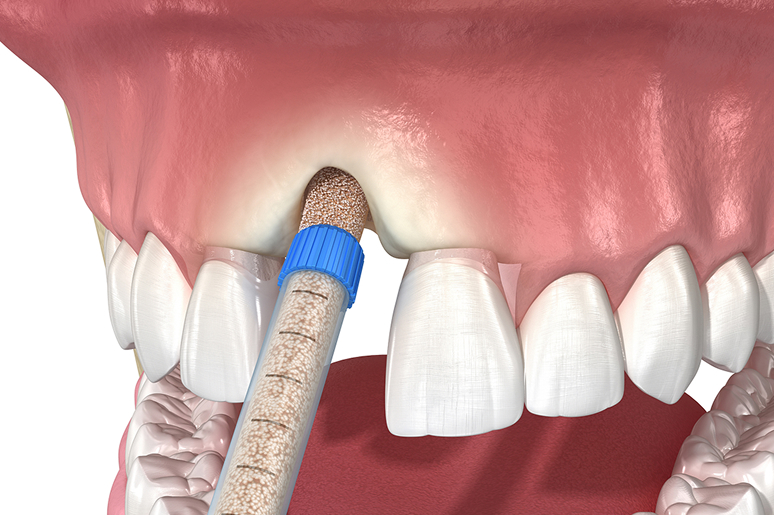
Your jawbone stays healthy and dense because tooth roots transmit bite forces into the bone, stimulating it to maintain volume and density. When a tooth is lost, that stimulation stops immediately — and the bone begins to resorb (shrink) within months. The longer a tooth has been missing, the greater the bone loss.
Bone grafting introduces graft material into the deficient area. Over the following months, your body's natural healing processes integrate the graft and generate new bone — rebuilding the volume and density needed to securely anchor a dental implant. It's the essential first step for many patients seeking implants after significant tooth loss.
GRAFTING OPTIONS
The right graft type depends on where bone is deficient, how much is needed, and the implant treatment you're planning. We'll explain your options clearly at your consultation.
Placed at the time of tooth extraction to fill the socket and prevent the bone collapse that typically follows. This is the single most effective way to preserve bone for future implant placement — plan ahead and avoid a larger graft later.
When significant bone volume has been lost after tooth extraction, ridge augmentation rebuilds the width and height of the jawbone ridge. Graft material is placed beneath the gum tissue and covered with a membrane to guide new bone formation.
For larger bone deficiencies, a block of bone (typically harvested from the chin or ramus of the jaw) is secured to the deficient area with small titanium screws. Over 4–6 months it fuses with the existing bone, providing a solid platform for implant placement.
A resorbable or non-resorbable membrane is placed over the graft site to prevent soft tissue from growing into the area before bone can form. GBR directs healing specifically toward bone regeneration, significantly improving graft outcomes.
The upper back jaw frequently has insufficient bone due to proximity to the sinus cavity. A sinus lift procedure creates space by gently elevating the sinus floor, and bone graft material is placed in the created space. See our dedicated Sinus Lift page for details.
In some cases of minor bone deficiency, bone grafting and implant placement can occur in the same surgical session — reducing overall treatment time. Your 3D CBCT scan will determine whether simultaneous placement is appropriate for your anatomy.
GRAFT MATERIALS
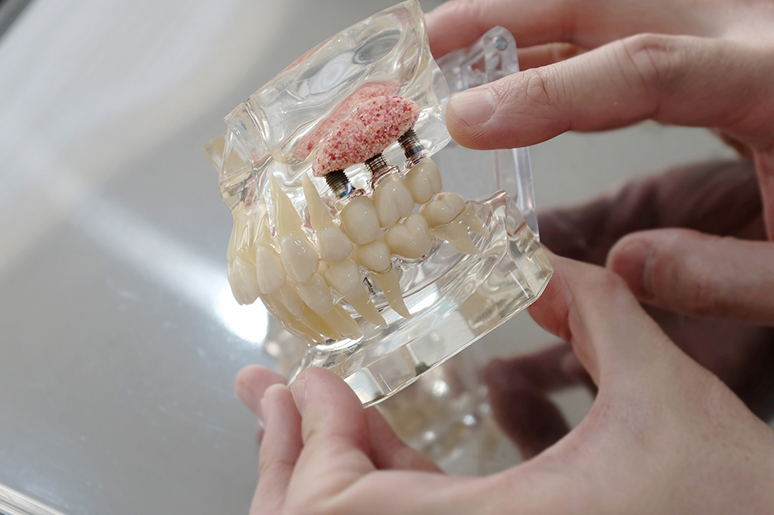
Modern bone grafting doesn't necessarily require bone harvested from your own body. Several highly effective graft materials are available, each with specific advantages.
We'll recommend the most appropriate material for your specific defect size, location, and implant goals at your consultation.
WHY TRUSTED DENTAL
We manage every phase of your bone grafting and subsequent implant treatment at our Hawthorne office — no oral surgeon referral, no coordination headaches.
We precisely measure bone defect dimensions in three dimensions — width, height, and density — before selecting the graft approach. This level of precision is only possible with CBCT imaging, not conventional X-rays.
Our dentists have completed advanced surgical training covering all bone grafting techniques. Hundreds of successful graft procedures have been performed right here — giving you the benefit of specialist-level experience without the specialist referral.
We use only premium-quality graft materials from certified suppliers — with a documented history of biocompatibility, predictable integration, and high success rates across thousands of clinical studies.
Bone grafting costs vary based on the size and type of graft required. We provide a clear, itemised quote covering your graft and your planned implant treatment together — so you can plan your full investment upfront.
COMMON QUESTIONS
Answers to the questions we hear most from patients in Hawthorne and across the South Bay.
Not always. Many patients have adequate bone and can proceed directly to implant placement. Our 3D CBCT scan will measure your bone volume and density precisely at each planned implant site. If bone is sufficient, no graft is needed. If minor deficiency is present, a simultaneous graft at the time of implant placement may be possible. Only significant deficiencies require a separate graft and healing period beforehand.
The procedure is performed under local anaesthesia — you won't feel pain during the graft itself. Post-operative discomfort is comparable to a tooth extraction: mild to moderate soreness and swelling for 3–5 days, managed with prescription or over-the-counter pain medication. Most patients return to normal activities within a week. The graft site then heals undisturbed over the next 4–6 months.
Most bone grafts require 4–6 months of healing before implant placement can begin. Larger block grafts may require up to 9 months. We monitor healing with follow-up X-rays and 3D scans. Once sufficient new bone has formed and the area is stable, we can proceed to implant surgery. We'll give you an estimated timeline specific to your graft at your consultation.
It depends on the material recommended for your case. Allograft (processed donor human bone) and xenograft (bovine bone mineral) are both commonly used with excellent long-term outcomes. All materials undergo rigorous sterilisation and quality testing. Synthetic alternatives (alloplasts) are also available if you prefer a material with no biological origin. We'll discuss your options and answer any questions at your consultation.
Yes — and this is the ideal time to graft. A socket preservation graft placed immediately at extraction time prevents the significant bone collapse that otherwise occurs in the months following tooth loss. If you know you'll want an implant, always ask about socket preservation at the time of extraction. It's a simple addition that can save a more extensive graft procedure later.
Book a free bone grafting consultation at our Hawthorne, CA office. We'll assess your bone with 3D imaging, explain your grafting options, and map your full implant treatment path with transparent pricing.