Missing upper back teeth and insufficient bone for implants? A sinus lift gently raises the sinus floor and builds new bone — making upper jaw implants possible for patients who were previously turned away.
WHY IT'S NEEDED
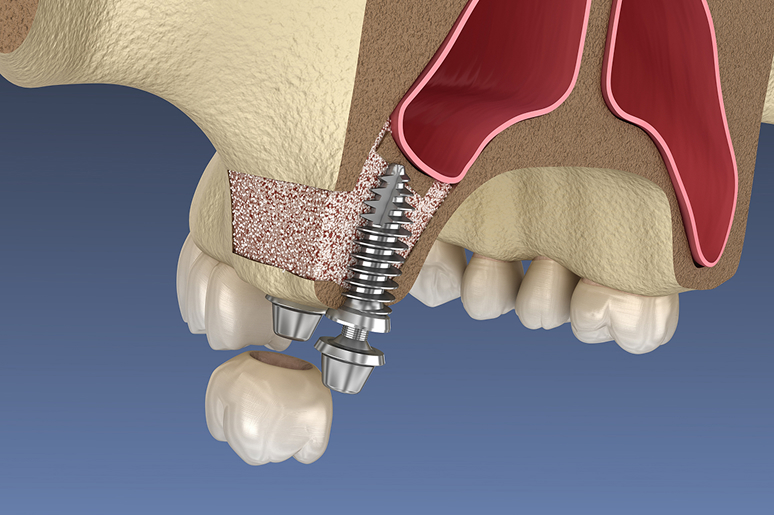
The maxillary sinuses are air-filled cavities that sit just above the upper back teeth. In many people, the sinus floor lies very close to — or even into — the area where implant roots would need to be placed. When upper back teeth are lost, the bone beneath shrinks further while the sinus may expand downward, leaving very little usable bone height.
A sinus lift (also called a sinus augmentation) is a surgical procedure that gently lifts the sinus membrane upward and fills the created space with bone graft material. Over 4–6 months, new bone grows in this space — providing the height needed to anchor implants securely without any risk to the sinus.
SURGICAL APPROACHES
The technique depends on how much bone height you currently have and how much new bone needs to be created. We'll determine the right approach using your 3D CBCT scan.
The traditional approach for significant bone deficiencies (less than 5 mm of available bone height). A small access window is created in the side wall of the sinus, the membrane is carefully elevated, and bone graft material is packed into the created space. Implants are placed 4–6 months later. This technique can create 8–12 mm of new bone height reliably.
A minimally invasive technique for patients with 5–8 mm of existing bone. The sinus membrane is elevated through the same access point used for implant placement — meaning the sinus lift and implant can often be performed in a single appointment. Suitable for smaller volume additions (3–5 mm of new bone height).
When bone height permits (typically 5 mm or more), the crestal approach allows us to place the implant at the same time as the sinus lift. This condenses the treatment timeline significantly — one procedure, one recovery, and implant osseointegration occurs while the graft heals simultaneously.
When bone height is critically low (less than 4–5 mm), a staged approach is safest: sinus lift first, heal for 4–6 months, then implant placement. This ensures the implant is anchored in fully consolidated, mature bone — maximising long-term implant stability and success.

WHAT TO EXPECT
A sinus lift is a precise, well-established procedure with a predictable recovery. Understanding what to expect helps patients feel confident and prepared throughout the healing process.
Most patients find the sinus lift recovery significantly more comfortable than they anticipated. Your care team will be available throughout to answer any questions.
WHY TRUSTED DENTAL
Our in-house surgical capability means your entire journey — from scan to sinus lift to implant crown — happens right here in Hawthorne.
We measure the sinus floor height, sinus membrane thickness, and available bone dimensions in three dimensions using our in-house CBCT scanner — allowing us to select the safest, most appropriate technique for your anatomy.
Sinus lift surgery requires precise, delicate technique to avoid perforating the Schneiderian membrane. Our team's advanced training and extensive case experience translates directly to safer procedures and predictable outcomes for patients.
We use only certified, clinically proven bone graft materials for sinus augmentation — selected based on the specific volume needed and your individual clinical profile for optimal long-term integration.
We quote and plan the sinus lift and your subsequent implant restoration together — so you know the total investment before any procedure begins. Financing covers the entire treatment as a single plan.
COMMON QUESTIONS
Answers to the questions we hear most from patients in Hawthorne and across the South Bay.
A sinus lift is a surgical procedure that increases the amount of bone in the upper jaw by gently elevating the sinus membrane (the membrane lining the maxillary sinus cavity) and placing bone graft material in the space created between the membrane and the existing bone. Over the following months, the body generates new bone in this space, creating the height needed for dental implant placement.
Patients who have been missing upper back teeth (premolars and molars) for a significant period, especially those with a naturally large or low sinus cavity, often have insufficient bone height for implants. Our 3D CBCT scan measures the exact bone height available. If less than 8–10 mm is present at the planned implant site, a sinus lift is likely needed. Not everyone getting upper jaw implants requires a sinus lift — many front and upper premolar sites have adequate bone.
The procedure is performed under local anaesthesia — you'll feel pressure and manipulation but no pain. Most patients report that post-operative discomfort is manageable with prescription pain medication and reduces significantly after the first 3–5 days. Swelling around the cheek area is common in the first week. Sedation options are available if you prefer to be more relaxed during the procedure.
Sometimes, yes. When at least 5 mm of existing bone height is present, we can often perform a crestal (minimally invasive) sinus lift and place the implant simultaneously in a single appointment. This shortens the overall treatment timeline. If bone height is critically low (under 4–5 mm), a staged approach — sinus lift first, then implant after healing — is safer and more predictable. Your 3D scan will determine which approach applies to your case.
No — a properly performed sinus lift does not affect long-term sinus function. The sinus membrane is carefully preserved and only elevated gently; it heals fully. Patients may experience temporary sinus congestion or mild bleeding from the nose in the first few days post-surgery, which is normal and resolves quickly. Long-term sinus problems following a sinus lift are very rare when the procedure is performed by an experienced clinician.
Book your free sinus lift consultation at our Hawthorne, CA office. We'll scan your sinus anatomy in 3D, confirm whether a sinus lift is needed, and map out your complete implant treatment path.